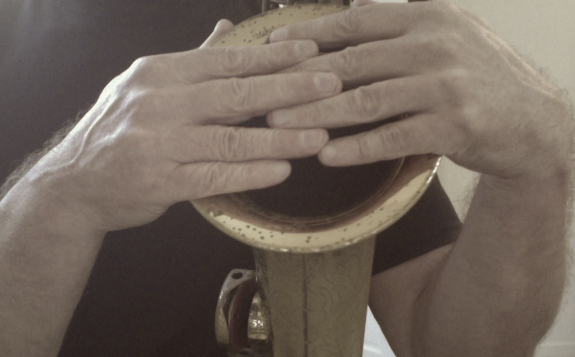
Refresh Your Thinking To Greatly Improve The Efficiency Of Your Practice

The quality of your practice is directly proportionate to the quality of your thinking. Contrary to what many musicians believe, you’re not “training muscles” as you practice, so much as you are directing your thinking so that your brain can readily coordinate the muscular activity necessary to play well.

Mindless, repetitive practice usually yields limited, often disappointing results. Deep practice, where you are cognizant of your specific, in-the-moment goals, as well as what you hear, and sense in yourself as you play, is what leads to consistent improvement.

If you practice when you are distracted (maybe you didn’t get enough sleep, are in an angry mood, worried, about something, really hungry, etc.), you know that you won’t do very well. In fact, you might even finish your practice session with the feeling that you wasted your time.

But what about when you’re fully present and focused for your practice session? Are there ever times when you need to check your thinking? My answer is a resounding yes!

The more efficient I become in my practice routine, the more I realize how important it is to refresh my thinking frequently. This calls upon my willingness to stop what I’m doing. To take the saxophone out of my mouth and regroup, so to speak. Not always an easy thing to to when I’m in practice mode. If I play a particular passage less than ideally, I want to jump right back in and get it “right”, without any thought about what I need to do to “get it right”.

But I’ve learned that stopping to check in with, and redirect my thinking is always a better choice than plunging forward again with another mindless, misdirected effort. It always makes the next attempt so much more efficient and constructive. So I’ve gotten pretty good at stopping.

After I’ve stopped, I usually refresh my thinking by asking myself a few simple questions:

  • Am I tightening my neck, shoulders and back?
  • Am I allowing the weight of my body to balance through my feet (when I stand as I practice)?
  • Am I mostly expanding or contracting (releasing or tensing)?
  • How is my breathing (effortless and quiet, or tense and noisy)?
  • Am I really listening to what I’m playing (as opposed to just hearing sounds)?
  • Am I clear about what my immediate goal is with this particular exercise, passage, etc?

I pause to ask myself these questions dozens and dozens of time as I practice. Then I return to my full stature (my full length and width), finding all the space in my body again, and recharging my senses. I return to the physical and mental conditions that I need to play my best.

I’ve gotten so good at it that I can make these assessments rather quickly, then get right back to playing my instrument. For me it’s almost like I’m pushing a “reset” button for my brain, or refreshing the screen of my computer. Everything seems to flow and fall back into place when I do this.

If you wanted to simplify it all, you could  ask yourself, “Am I tending more toward contraction or expansion as I play?” Included in this question (besides noticing your body) is your ability to listen to and hear yourself. Are your senses going inward (contracting), excluding the full experience of your sound,  or expanding outward into the room where your sound actually is?

If you ever feel yourself becoming frustrated and/or fatigued as you dig deep into your practice, consider this idea of stopping and refreshing your thinking. Taking time to pause and redirect your thoughts is never a waste of time when you practice. Never. You’ll find (as I and my students have) that by stopping briefly to refresh, you’ll return to the task of practice with greater focus and clarity. You’ll make fewer mistakes (which means you’ll spend less time making unsuccessful “takes” of whatever you’re working on). In short, you’ll get more done in less time. Really.

Plus, you’ll develop a good  standard for awareness that you’ll bring into your performances. All good news.

And if you’d like to stop and take a slightly longer moment to refresh your thinking, you might want to think to yourself the Alexander Technique directions:

I allow my neck to be free, so that my head releases upwards on top of my spine, (I don’t tense my neck and jaw, jamming my head downwards into my torso)

so that entire torso can lengthen and widen, (I don’t tense my shoulders, back and ribcage)

so that my knees can release forward and away, (I don’t tighten my pelvis to draw my legs up tightly into my hip joints; I don’t lock my knees.)

so that my heels can release into the ground. (I don’t tense my feet and ankles, so that I allow the weight of my body to go through my feet)

These directions are a good description of what happens as you release tension and expand back to your full stature. If you practice using them consistently, you’ll get consistently good results (both I and my students have).

But whether you use these directions, or ask yourself the kinds of questions that I’ve listed above, or simply remind yourself to pause for a moment to regain your stature and your clarity, make a point of stopping to refresh your thinking.

Make it an aim as you practice, and acknowledge and reward yourself with encouragement when you’ve succeeded in doing so. Ask yourself, “How many times was I able to stop and redirect my efforts in the 15 minutes I’ve spent working on this particular exercise?” Notice that when you do this, you play with much less tension, and greater clarity and consistency. Make this a part of your practice habits, and you’ll be pleased with the results.

A Simple Way To Open Up Your Rhythmic Imagination

The art of musical improvisation involves imagination and ability: An unfettered muse supported by the specific skills necessary to turn creative impulses into clearly expressed ideas. It is the discipline of musical composition carried out moment to moment. In real time.

Because of the “real time” demands of improvisation, it’s natural for our brains to find patterns to rely upon to simplify the task. This is both good and bad. Good because it leads to connectivity, cogency, fluidity. Bad because it can also lead to us getting stuck playing many of the same things the same way over and over again.

As I listen to many jazz improvisation students, I’m many times struck by the lack of rhythmic imagination in their improvisation. In jazz pedagogy there is, in my opinion, too often an over emphasis on pitch studies (harmony, scales, passing tones, tensions, resolutions, etc.) at the expense of rhythmic studies.

Don’t get me wrong.  I think it is absolutely essential to gain control over this vast amount of tonal material in order to improvise deeply, effectively and personally in the realm of modern jazz. (Lots to practice!)

Yet it is the energy of movement that turns pitch choices into music. That’s where time and rhythm come in. But too often I hear jazz improvisers playing the same rhythmic patterns,  the same predictable accents, with far too much of an cadential emphasis on the form of the song they’re improvising over.

When I give a first lesson to a student of improvisation, I’m listening for many things, trying to get an idea of where they’re at with their skill and conception. Whenever I hear a student that can play with a considerable amount of fluency (holds the song form and makes the changes with relative ease), but a rather limited rhythmic conception, I always ask how he or she practices the materials of the music (scales, arpeggios, intervals and other patterns).

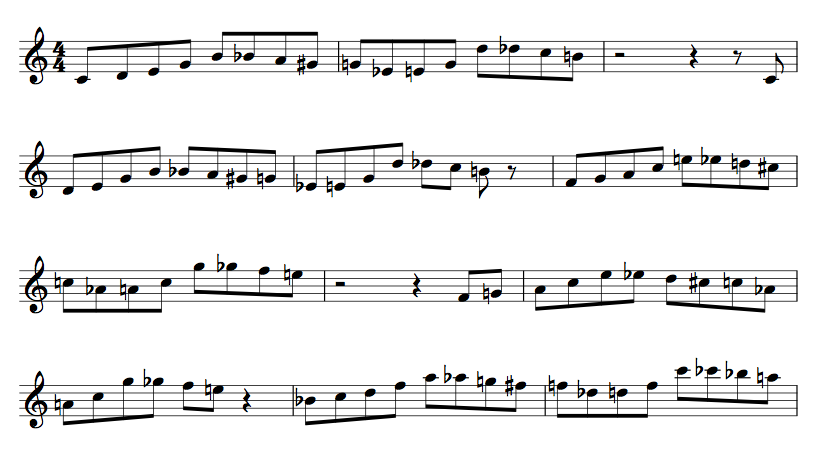
What I usually observe as the student plays through scale, arpeggio and other exercise patterns is far too much respect to a “4/4” kind of symmetry. Everything fits nicely into the bars and ends on the downbeat. For example, secondary triads in major keys (C major here as an example) might be played as follows:

As you can see, there is a metric grouping of 4 notes emphasized by virtue of the tonal pattern. (I use accent marks here to outline the rhythmic subdivisions). There’s nothing wrong with practicing this pattern in this manner, but you must realize if you (or my student) were to do so exclusively (or even primarily), you’d be seriously limiting how you might use this intervallic movement in your improvising. Lots of emphasis on the downbeats, and lots of emphasis on the “box” of the four bar pattern.

In essence, you’d be depriving yourself the opportunity to develop your rhythmic imagination and control to its fullest. No matter how much harmonic material you get under your fingers and into your ears, you’d be missing out on so many movement possibilities.

So a very simple thing you can do in your practice to open up your rhythmic imagination is to avoid putting all your scale, arpeggio and interval patterns in these neat little boxes.

Here are three techniques you could employ to make the pattern  from above a bit more interesting and challenging while still maintaining the continuity of the line:

1. Rhythmic displacement-You can move the starting note of the pattern to different places in the bar. Here are two examples:

In the first example I displace the pattern by one half beat by starting on the upbeat of one. This kind of playing “turns the time around” so that the downbeat sounds like the upbeat. The second example has the pattern displaced by one full beat. You could go on and displace the pattern on each part of all four beats, learning to feel the movement of the pattern from many different angles.

2. Polymetric modulation-By slightly modifying the notes in the pattern you can imply different meters. (I’ve used accents to clarify.) Here is a 3/8 over 4/4 pattern:

I’ve modified the pattern above by simply omitting the fourth note (the repeated 3rd of the triad) of each group.

Below is a 5/8 over 4/4 pattern which I create by adding a fifth note to each previous group of four notes (the root of each triad):

And here’s a 7/8 over 4/4 pattern (accents on groups of 4 and 3).  This pattern is a bit more complex, but easy to understand. I simply remove the fourth note (again, the repeated 3rd of the triad) from every other previous group of four notes.:

(If you’d like to explore polymetric modulation and rhythmic displacement in a thorough, methodical way, please consider my eBooks, Essential Polymeter Studies in 4/4 for the Improvising Musician, and Rhythmic Dissonance.)

3. Rhythmic modulation-By placing a 4-note grouping in the pulse of a triplet, you can create an interesting kind of rhythmic tension:

You could also use the same kind of metric modulation to with the other modified patterns from above. There are many, many ways to vary this simple triad pattern.

And I haven’t even touched upon the possibility of adding more variety by combining rhythms (mixing eighth notes with quarters, sixteenths, using ties, rests, etc; that’s a topic for another article). As I mentioned earlier, I wanted to show you here how to play patterns with a continuous pulse.

So try some of these technique next time you practice your scales, arpeggios and intervals. (If you like to play licks and other patterns you’ve learned from transcribing solos, you could also practice them in this more rhythmically multi-dimensional way.)

Of course, you should always use a metronome to check your accuracy and control. Practice each pattern with the metronome clicking on each beat, and with the click only on beats 2 and 4 (backbeat swing feel).

And if you’d like to approach these kinds of variations and explorations in time, rhythm and meter in a more methodical, challenging and comprehensive way, you might consider my e-book, entitled Rhythmic Dissonance.

Make it your mission to find new ways to work out your melodic material in a less predictable way as you expand your tonal language.

Having the ability to call upon these rhythmic devices and learning how to “land on your feet” (always knowing where you are in the bar) will vastly improve your spontaneity and control as you improvise. If you make this a regular part of your practice you’ll really surprise yourself with how you can think and move in new ways. Imagination supported by skill.

Here’s a video performance of the late, great, Warne Marsh playing Body and Soul. Listen to how he floats and subtly shifts the cadences of the song and beautifully creates and resolves rhythmic tension against the steady pulse provided by the rest of the band. A master at work. Enjoy:

Want To Increase The Duration And Intensity Of Your Practice? Think Like An Athlete

OLYMPUS DIGITAL CAMERA

So you’re inspired to take your practice to a new level of commitment. You’re ready to spend the time and the energy. Ready to become more focused and disciplined. That’s great! Riding that wave of enthusiasm is going to take you into a deeper realm of self-expression (and satisfaction).

I’d like to offer an idea that might help you make that transition in your practice time more effective: Think like an athlete. After all, athletes and musicians have something in common. Both  spend lots of time practicing precise, repetitive movements.

Many years ago I became deeply involved in endurance sports (cycling and triathlon, in particular). Any wise endurance athlete knows that training has to be done in cycles. You simply can’t train hard all year long (potentially injurious and counterproductive). You need a program that includes carefully planned work at different levels of intensity and duration, as well as plenty of strategically applied rest.

Competitive endurance athletes often plan their training in yearly cycles (including several shorter cycles nested within the year), with specific goals about when to be in peak condition for particular events. At the end of every competitive season comes the “off-season”, which is essentially a carefully prescribed period of rest.

This rest season is absolutely essential to the continued success of the athlete. It promotes mental and physical recovery, as well as providing an important period of reflection about the effectiveness of the training efforts of the previous season.

After this rest period, the athlete begins to train again. And the smart athletes realize that they need to scale back their efforts considerably from where they were at the end of the previous season.

They can’t just start hitting it hard, no matter how enthusiastic they are. (This is true even if the athlete has maintained a reasonable amount of fitness throughout the off season by means of  less intense, yet regular physical exercise and activity.)

And the same is true for musicians. Even if you’ve been practicing regularly (let’s say, for example, an hour a day) and you want to significantly increase your practice time, you’re best off by doing it gradually.

One of the best pieces of advice given to me by an excellent cycling coach some years back, has also helped me in my practice as a musician. He said to attain the optimum results when increasing my training efforts, I should always aim for “teasing myself” into better condition.

In other words, each training session should leave me feeling like I want to do a bit more, go a little further. And then the next day, I dig a little deeper, but still “teasing” myself into condition. Still hungry and curious for more.

As you might guess by now, this approach to physical fitness training has helped me significantly as I apply it to increasing my musical practice efforts.

Many of the musicians that come to me for Alexander Technique lessons do so because of chronic pain and/or injury they’re experiencing as they play music. There are several causes of their pain: excessive tension, misdirected muscular energy, distorted posture, to name but a few. Often these problems are exacerbated by practicing “too hard”.

So besides teaching these musicians how to play with far less effort and tension, part of my job is to teach them how to safely build their practice intensity back up. I show them how to “tease themselves” into better condition.

Here are some things you can do to help you safely and effectively increase the intensity and duration of your practice:

  • Stop before you get tired. Don’t bring yourself to exhaustion during any point in your practice session. Even though you’re working hard, aim for feeling energized as you finish.  A “good kind of tired”, instead of a complete wreck.
  • Improve your awareness as you practice to notice where and how you might be working too hard. In particular, notice your neck, shoulders, back and legs. Think release and mobility instead of tension and holding.
  • Notice your mental states. Are you able to bring 100% of your attention to the act of practicing? Are you thinking clearly each time you start a new phrase (or attack a note)? Do you feel “foggy” or fatigued during any point of your practice session?
  • Recognize intensity. Not all practice is equal. One hour of long tones in the upper register of a brass instrument is far more taxing than 2 hours of easy, melodic etudes in the lower and middle register. So don’t just think practice time, weigh in intensity as well. Be willing to make a shorter session if it has more intense work in it.
  • Become disciplined about time. Work in pre-specified amounts of time. Avoid going from practicing one hour a day to 3 hours in one session. Spend a few weeks building up to this duration.
  • Become disciplined about stopping. I rarely practice anything for more than 15-20 minutes without putting my saxophone down and walking away from my practice area, even if just for a couple of minutes. If you get in the habit of doing this, you’ll avoid a significant amount of accumulated fatigue (both physical and mental). Also, give yourself permission to stop at any moment you feel like you’re straining or misdirecting your efforts. Mastering the art of stopping is essential to your safety and your improvement.
  • Become disciplined about resting. This goes hand in hand with stopping. Rest many times during a practice session, turning a one hour period into 4 short practice periods with a few minutes of rest between each. Then give yourself a good 5-10 minute rest at the end of the hour. Lying in constructive rest is a great way to recharge your batteries at the end of each practice hour. Take a day off each week from practicing.
  • Think in training cycles. Just like the endurance athlete, modulate your training efforts. Have some easier days, some more intense days. Also consider easier weeks, and more intense weeks.
  • Make your aim to finish each session wanting more. This brings us full circle to my first bulleted point above. Put your instrument away with a sense of curiosity, a sense of longing to explore more, to go deeper. At first this might seem unsatisfying (or even frustrating), but as you gain control over your ability to stop, your ability to rest, your ability to manage your time effectively, you’ll find a deep sense of accomplishment and confidence in your practice efforts (not to mention you’ll really improve your playing!)

The similarities between the musician and the athlete are many, and I’m certainly not the first to have drawn these comparisons. By thinking more like an athlete, you’ll change your practice in a positive, progressive and sustainable way.

Advice For Improving The Speed And Accuracy Of Your Fingers

In my experience teaching the Alexander Technique to pianists, string and woodwinds players, I often encounter a similar kind of counterproductive thinking concerning the hands and fingers. Specifically, too much attention is placed upon what the hands and fingers are doing.

Not only does this divide the musician’s attention, often cutting off the awareness of what’s going on in his/her body as the music is being played, but also, it interferes with hearing pitch, timbre, and perceiving time clearly.

And sadly, all this attention on the fingers doesn’t even make them work better. Quite the contrary.

Here are a few examples of the kinds of problems with hyper-awareness of the fingers that I’ve come across with my students:

  • A saxophonist who is consciously trying to keep his fingers very close to the keys (in an effort to not “waste” movement and play more “efficiently”). In doing so, he makes his entire body stiff and his fingers sometimes can’t move in response to the demands of the music. He’s stuck.
  • A pianist who stares constantly down at her hands as she plays, making sure her fingering is “correct” as she plays an unusually high percentage of wrong notes on a piece that she knows quite well.
  • A violinist who can’t keep his eyes off his fingers for fear of playing out of tune. (Ironically, as soon as he takes his eyes off his hands, his pitch improves dramatically.)

The simple truth is that if you want to improve how your hands work as you play, you have to leave them alone, so they can do the right thing without interference. To do this you have change your thinking. You have to replace the thought of your fingers “doing the right thing” with a broader kind of thinking.

First, start with the aim of being free in your body as you play. In particular, ask yourself for freedom in your neck, shoulders and back. This alone will not only change the quality and quantity of muscular tension as you play, but also, will calm and center your mind and improve your breathing.

Make this a top priority as you practice. The freer you are in your head, neck and back, the freer your fingers are to move and create the stability necessary to play your instrument.  This is something you’ll need to practice as you practice (yes, I meant to say that). Here’s a previous article I’ve written about practicing paying attention to help you with this.

Next, rather than trying to feel how (or what) you think your fingers need to feel, think instead of where your fingers need to go as you play from one note the next.

By taking your attention from what you feel to where you are going, you increase your spatial awareness (and improve your sense of time, as well). Your brain organizes the music making task in a fundamentally different way, allowing your fingers to move freely, easily and quickly. In the simplest sense, you get out of the way of your brain’s ability to organize and control complex movement, so it can do what it needs to do unimpeded.

This is something that can be practiced gradually, using simple visualization:

For example, if you’re a saxophonist, practice a very easy, familiar pattern (arpeggio, scale, intervals, etc.) at a slow tempo as you think, not of what your fingers are doing, but what keys need to be pressed and/or released as you go from note to note. Think ever so slightly ahead to the next note to be played as you land on each note. If you practice this regularly, you’ll learn that you can play rapid passages that you couldn’t play before with stunning ease and clarity. (Same general idea if you play piano, strings, etc. Think where on your instrument you want your fingers to land, not what your fingers have to do.)

Finally, replace the thought of fingers with tonal imagination. Practice singing passages or patterns that you find difficult on your instrument. First, sing the passage slowly and very precisely, making sure the sequence of pitches and the rhythms are crystal clear in your mind. Once you’ve accomplished that, play the passage by following your ear. Really hear the passage clearly in your mind, and don’t worry about what your fingers have to do.

Most of the chronic technical difficulties musicians struggle with are a result of tense anticipation. Hyper-awareness of the fingers is akin to driving a car on the highway at top speed with your eyes planted downward on the road in front of you. Scary and stiff. Same thing on your instrument.

So change how you think about your fingers. Practice consistently shifting your attention from your fingers to your broader senses, and you’ll be surprised how limber and accurate your technique becomes.

Innovation Or Authenticity?

There seems to be a conflicting theme these days expressed by some veteran jazz musicians (from the widely know to the more obscure) about the current culture of young, “up and coming” artists.

On the one hand, I hear many complaints about the lack of individuality in sound and approach perceived in many of these young musicians: “They sound generic. There’s nothing that identifies them immediately in what they play. When Coltrane, Miles or Monk played,  you could tell it was them in one note.” (I’m paraphrasing here.)

On the other hand, there are complaints about a “culture of innovation” amongst younger artists  that is sometimes perceived as being overly self-conscious: “What they’re playing sounds so forced, so unnatural. It doesn’t have a strong enough connection to the tradition. It comes across as too cerebral. It doesn’t swing.” (Again, I’m paraphrasing.)

I’m not here to agree or disagree with the sentiments expressed above. Rather, I’d like to talk about this conundrum specifically. I’ll start with this rhetorical question: As an artist, is it more important to be innovative or authentic?

Both innovation and authenticity have great value in art. In the world of jazz, some of the greatest, most influential improvisers have been stunningly innovative.

Besides the three I mention above, we have Duke Ellington, Louis Armstrong, Lester Young, Ornette Coleman, and Charlie Christian, Kenny Clarke, to name but a few. All of these artists have radically opened up the possibilities of self-expression in jazz by expanding and redefining the role and/or capabilities of their respective instruments in the act of improvisation (or in the case of Mr. Ellington, compositional and orchestral possibilities).

But we also have a wealth of artists who are less innovative, yet highly influential and highly valuable to the jazz lexicon. For example, Cannonball Adderley, Kenny Dorham and Kenny Barron, though they didn’t “expand” the boundaries of the music to the degree some others have, are strong and vital influences to the music.  (Great artists with distinctive voices on their respective instruments!)

Whether more an “innovator”, or more a “traditionalist”, or “stylist”, all great artists have one thing in common: Clear, immediate authenticity.

As Thelonious Monk said (another powerful innovator in jazz!), “A man’s a genius just for looking like himself.” I think it’s safe to say all the musicians I’ve mentioned above most certainly fall within Mr. Monk’s definition.

Which brings me to my point: Whatever you want to do as a musical artist, place authenticity first.

By allowing for authenticity (yes, allowing), you free yourself from expectations. (You have nobody to answer to but your own muse, your own impulse to make music.) You free yourself from lots of stifling judgements about your music. (It doesn’t matter how “unique” your music is, as long as it flows freely and generously from you.)

In essence, when you express yourself authentically through your music, you are in a constant state of gratitude. You accept the music that comes through you as a gift, and you share it with the world. You are open and welcoming to so much: ideas, sound, connections with other musicians, time, rhythm and more.

I think it’s important to keep in mind that the vast majority of innovators in the history of jazz weren’t trying  to be innovators. They were just working with the materials of music as they found their way to their own need for artistic expression. They were “looking like themselves” as they followed their curiosity and passion.

It’s probably impossible to consciously try to make music that is “innovative”. For music to be deemed innovative, it must, by definition, change the course of the art form, and significantly expand the vocabulary of the expressive language. It must have a measurable, lasting influence on the artists of the present and of the future. That’s huge. You can’t force that happen out of sheer will. It either does or doesn’t.

Just like the greats, all you can do is follow your curiosity and passion. If your music is innovative, it will most likely rise from  a natural and authentic curiosity. Curiosity about the materials of music, curiosity about your instrument, curiosity about yourself. And passion as the fuel for action (practice and study).

Aim for making music that is truly beautiful to you. Don’t second guess it. If it touches you, it will, without doubt, touch others. And that makes what you do so valuable. Don’t let the need for innovation steer you into making music that isn’t beautiful to you. (Likewise, don’t let the fear of unknown artistic territory keep you from surprising yourself with new musical discoveries.)

Allow the possibility that your viewpoint (tastes, ideas, values, perception, etc.) can change and grow. As I get older, my music making seems less conceptual and “cutting-edge” to me, but so much richer, more clearly conceived, more expressive and more beautiful than ever before. (It’s more me than ever before.)

Whether or not your musical expression falls well inside the mainstream, or far from it, if you hear and feel something that lights you up,  go after it. As long as it’s it’s truly yours, you’ll be glad you did.

Who are you?” is the question that can best guide you. So take plenty of time to stay on the path of self-discovery as you cultivate your curiosity and expand your possibilities. Enjoy the beauty you create along the way.