Are You Trying To Hear Your Sound By Creating Excess Tension?

The other day, as I was working with a new Alexander Technique student, I encountered (again) a fairly common habit that many musicians have that usually leads to trouble. Allow me to share.

My student is a singer who came to see me because of problems she’s been having with vocal strain and intonation. As she told me: “I seem to start out okay (actually, she sounds very good), but after about 5 to 10 minutes of singing my voice becomes strident, kind of thin, and my intonation gets difficult to control.” She sang for me for a few minutes and confirmed her own assessment.

It wasn’t hard for me to see how she was creating these problems for herself. As she’d start singing I’d see her stiffening her neck as she thrusted her face upward and forward. This pattern of tension manifested itself through her entire body: shoulders pulled back, lower back arched, knees locked, unyielding ankles and feet.

So I began to work with her with my hands to help her find an easier state of balance as she was standing (without singing).  She was very responsive to the directions I was giving, and was really beginning to release much of her habitual tension: freer neck, widening shoulders and back, neutral pelvis,  softening knees, flexible ankles. She said she felt like “a whole new person”. All good stuff.

In Alexander slang, I’d say she went from doing too much, to a nice state of non-doing (leaving herself alone, to allow for a natural, virtually effortless balance).

I explained to her that this  state of non-doing was a very good place from which to start singing. It was like starting with a blank canvas, and could help her see how much tension she was creating when she sang. So I asked her to sing.

She went immediately from a calm, pliable, free state, to one of immense tension (same pattern as before: head thrusted forward, narrow shoulders, etc.) I asked her if she could sense all that tension she created as she began to sing, and she replied (with a certain amount amazement) that she could:

“Wow! I had no idea I was doing so much in my entire body to try to sing. Working way too hard…”

So I asked her to sing again, but with the thought of not going into that tense pattern, of leaving herself alone. But as she sang again, there was little, if any difference. She’d go right into that tense pattern again.

(This isn’t uncommon when encountering performance habits. They can be quite stubborn. Yet if addressed effectively and consistently, they can be changed. That’s what the Alexander Technique is all about.)

As we proceeded to work more with her singing, my student suddenly came to a great realization: “You know, I think I’m making all this tension in myself as an attempt to hear my voice.”

And she is absolutely right.

You see, to her (and to so many musicians) the sound  is more than what the ear takes in. It can involve other senses (feeling resonance, for example), beliefs (often also about what should be felt), and other expectations.

In the case of my student, she was trying to feel the sound a specific way. She said that’s how she was gauging her intonation. Yet by her own admission, her intonation was dubious as she created this tension.

So we worked on getting her to change her thinking. We shifted the goal from trying to sing well, to leaving herself alone as she sang: no face thrusting, no shoulder raising, no back arching, no knee locking. The aim was not to sing in tune, or even with a good sound. Rather, it was to begin to sing without going into her habitual tension. It would be a bit of an experiment.

In fact, I told her that if she sounded bad, even worse than she’d ever sounded, that she could consider herself successful in this experiment, because it shows she did something differently. She liked that idea.

Well, after a few takes, she finally had a moment when she started to sing without her habits. I had my hands on her, and could tell that she was leaving herself alone very nicely. She continued to sing for about 5 minutes. Her voice was clear, beautiful, consistent…and her intonation was spot on.

She was thrilled, to say the least. “That was hard. I don’t know if I could do that again”, she said. I assured her she could, perhaps not consistently at first, but eventually she’d be able to with considerable consistency.

I asked her, “How was your intonation? Did you notice it?” She replied, ” Oh yes, I could her my pitch so clearly and easily. But the strange thing was, I wasn’t trying to hear my pitch. I could just hear it, and knew it was fine.”

I explained to her that it was this “trying” to hear her pitch that was tempting her to create so much bodily tension, and that this excess tension was interfering with her ability to truly hear herself. That seemed to make sense to her. I’m excited to meet with her for her next lesson to see what else she’ll discover.

As I stated above, so many musicians I teach are struggling with the same habit: trying to feel their sound, both color and pitch, through excess bodily tension. Besides being counterproductive to the goal of a good sound and good intonation, it also carries with it the risk of strain, injury, poor technique and fatigue.

But there’s also something that comes with it that is equally negative. All that tension leads to a kind of physical and artistic prison when making music. You can become so dependent upon feeling your tension that you’re not free to experience the possibility of the unknown, the possibility of discovering something new in yourself as you make music.

So how are you when you play? How much tension do you create as you get ready to play your first note? Remember to allow your neck to stay free so that your head can balance easily on top of your spine. Let your shoulders widen. Don’t lift your chest and arch your back. Don’t lock your knees. Let the weight of your body travel easily into your feet as you let your ankles remain free and mobile.

Leave yourself alone as you play, and you’ll hear yourself so much better. To paraphrase F.M. Alexander, “If you stop doing the wrong thing, the right thing will do itself.” My experience as a musician and as a teacher (and student!) of the Alexander Technique affirms this every day.
Practicing Improvisation: Two Essential Components To Develop For You To Improve

To improvise fluently, expressively and authentically, you need to develop good ears. You must be able to find the notes  on your instrument that you’re hearing in your head (immediately!) as you play from moment to moment.

So it’s no wonder that ear training is a significantly large component in the study of jazz. Learning to recognize (and sing) intervals, chords, scales, rhythms, melodic patterns, etc. (not to mention transcribing solos.), is essential jazz pedagogy. If you’re a dedicated student of jazz  (or virtually any other form of improvisation) chances are you’ll spend the rest of your life refining your aural abilities. And that will pay off in a big way.

But as important as it is,  a good ear alone will not insure your growth and improvement as an improvising artist. For that to happen, you have to also develop another very important component: imagination. All the ear training in the world won’t do you much good if you can’t imagine (hear) anything to play.

The great tenor saxophonist, Joe Henderson, was known to have exceptional ears. He could effortlessly and immediately play back anything he could hear or imagine (or anything any musician could play). Yet he also spent his entire life continuing to practice the materials of music: scale patterns, inversions of arpeggios, melodic sequences, interval patterns, rhythmic patterns and more.

Why would he find the need do this if he had such splendid ears? So that he could continue to expand his musical imagination.

Ears and imagination. These two components go hand in hand, of course, and one really helps the other.

Take solo transcription, for example. If you transcribe a solo from a recording, you challenge your ears. The more you practice transcription, the easier it becomes. You go from struggling to hear things note by note, to recognizing patterns, melodic cliches (“licks”), chord and scale inversions, harmonic substitutions…entire chunks of music at a time.

But you also get more from the transcribing process. By listening to and analyzing a beautifully improvised solo, you also get a chance to look inside the mind of a great improviser. You get to see how this artist thinks about using the materials of music.

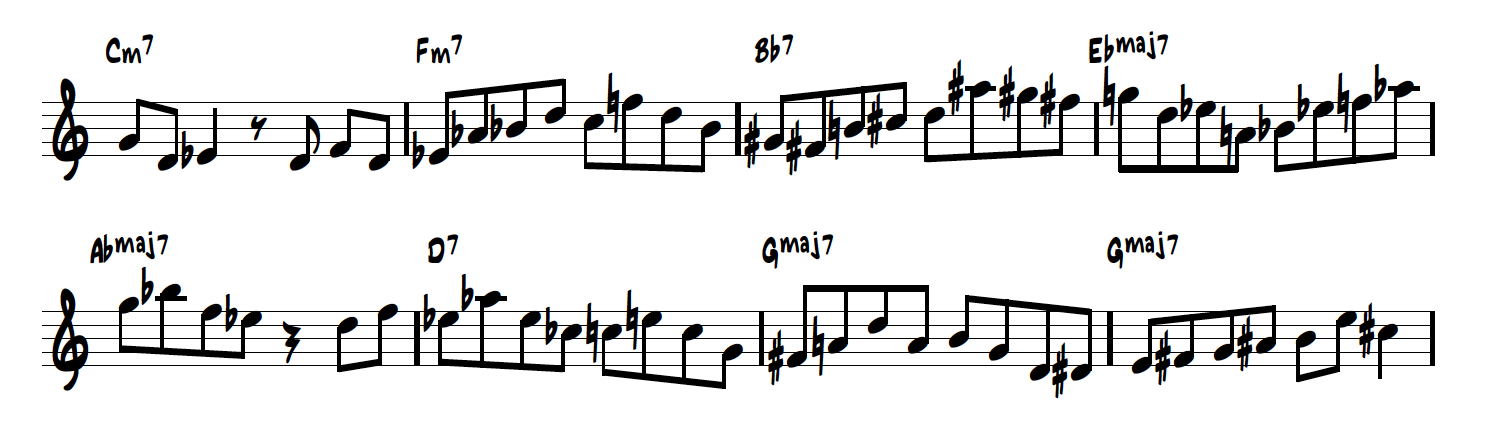
Let’s say you find a line in the improvised solo that you especially love. As you sit down to analyze it, you might find that it’s nothing more than a way of organizing the notes from a particular scale (that you already know very well) in a way that you’ve never considered.

From there, you would perhaps make a little exercise out of this pattern you’ve discovered, putting it in all 12 keys. Nicely done. Not only have you improved your ability to find pitches on your instrument (your ears), but also, you’ve expanded your conception of what is possible for you to imagine.

This is a matter of coupling your aural skills with your intellect, and is essential for you to continue to grow as an improvising musician.

When teaching improvisation, I want to hear two things in the first lesson: how you improvise as you play your instrument; how you improvise as you sing. This always gives me a good starting point.

Do you sing a beautifully clear, harmonically sophisticated, melodic and expressive solo, but have a hard time finding those same pitches and rhythms on your instrument? If so, your ears need to catch up with your imagination. (You might also need to address your instrumental technique.)

Do you improvise with reasonable fluency on your instrument, but sound like you’re thinking, instead of feeling, what you’re playing? If this is the case, your singing will most likely be far less sophisticated harmonically than  what you express on your instrument, showing a definite lack of aural imagination.

Does your time feel and rhythmic conception on your instrument match up to what you sing as you improvise? How is your phrasing different from voice to instrument?

Even after you’ve effectively addressed any imbalance here, you must ultimately continue to develop both your ear and your imagination if you want to grow.

Some things you can do to improve your ear:

  • Learn to identify all the intervals, scales, and chords by ear (nowadays there are great smartphone apps that help you do this at a really low cost)
  • Practice sight singing, solfege, etc. (in other words, be able to sing what you’ve learned to aurally identify)
  • Transcribe other people’s music (solos, melodies)
  • Transcribe yourself (both singing and playing)
  • Play along with recordings where you have no idea of key center, harmonic progression, etc. (try to simplify what you do to find notes that seem consonant with the recording)
  • Play something by ear everyday, even if it’s just simple, familiar melodies (folk songs, children’s songs, etc.)
  • Compose melodies by ear (no help from your instrument)

Some things you can do to expand your imagination:

  • Always be thinking about new ways to organize scales, arpeggios, intervals, etc. Use your intellect. Think in numbers if you like. Ask yourself, what would it sound like if…?
  • Listen to lots and lots of music, especially music that’s outside of your improvisational genre. Examine different disciplines, cultures, time periods, etc.
  • Transcribe other people’s music (yes, I’ve already mentioned this above!) It’s important to remember that when you transcribe, you’re improving your ear as you develop your musical intellect.
  • Find some good etude books for improvisation. Nowadays there is a wealth of excellent material to get you to think of tonal organization, harmony, thematic development and rhythm in increasingly sophisticated ways.
  • Study rhythm. Find books to work out of. Explore odd metered music. Figure out ways to turn your “4/4” ideas into odd numbered groupings. A great rhythmic imagination is the ultimate improvisational tool.
  • Practice etudes written for instruments other than the one you play. John Coltrane used to practice harp etudes.
  • Take a lesson from a great teacher. You’ll probably go home with month’s (if not year’s) worth of valuable homework.
  • Write your own etudes. Try composing solos over standard chord progressions, for example. This is a great chance to use your intellect and imagination to fatten your ears and clarify what you feel musically.

Above all remember that you can only play what you can imagine, and that you’ll play at your greatest potential when your imagination grows as your ear improves.

The Nagging Truth About Chronic Pain And Injuries

Recently I was reading a thread on a Facebook page (for saxophonists) about chronic pain. The thread started out asking about the value of chiropractic work for musicians, then quickly morphed into a discussion of the merits and/or shortcomings of various modalities to address pain and injury.

Lots of experiences, opinions and ideas were offered up. Several of the participants stated that chiropractic was not addressing the root cause of the problem. They thought that simply manipulating the bones neglected the deeper issue of muscles, fascia, etc. (I don’t necessarily agree with this, by the way).

Others talked about the the value of a good physical therapist to address muscle imbalances and flexibility issues. Deep tissue work was endorsed with great enthusiasm by others. Iyengar Yoga, Pilates, Myofascial  Release, and other therapeutic work were also mentioned.

The thrust of the discussion was about getting to the root cause of chronic pain. Lots of debate about the hierarchy of importance of the structures of the body (bones, nerves, muscles, fascia, joints, discs, etc.) in preventing  pain and injuries.

Yet nobody once mentioned the real root cause of most chronic pain and injury: Habit.

Your habits of thinking determine your habits of posture and movement. Period. You move and maintain posture in accordance to your conscious (and even unconscious) thoughts. And what predominately causes pain and injury for musicians (and others, as well) are dysfunctional postural and movement habits.

When you practice your instrument, you’re repeating movement patterns over and over, hundreds of times in a single session. If you’re doing this in an overly tense and unnatural way, you’re going to invite problems.

To be clear, I think there is a great value in the majority of the modalities that were discussed above. Without a doubt, manipulative work (massage, chiropractic, acupuncture, Myofascial Release, etc.) can be highly effective for ending the pain by bringing the structures of the body back into a healthy balance. It’s often a great place to start to get quick relief from pain.

Well prescribed exercise (Yoga, Pilates, etc.) can also help to change the structural organization of the body, which can help significantly in the long run.

But ultimately,  unless you change how you maintain balance, posture, and how you move in general (with and without your instrument) throughout your daily activities (i.e., change your habits), chances are good that you’ll eventually return to having the exact same kinds of structural problems you had before treatment (or exercise program).

So what are your choices? You can continue to get the same treatment, viewing it as a kind of “maintenance” for your pain. You can try a new form of treatment or exercise and see if that makes a lasting difference.

Or you can learn to change the habits that are causing your pain. You can learn to replace tense, harmful movement with light, safe and easy movement.

Besides being a professional saxophonist, I’m also a certified teacher of the Alexander Technique, and I’ve found this Technique to be the most effective way I’ve yet to discover to make lasting changes in postural and movement habits. If it weren’t for this work, I would no longer be able to play saxophone. As it is, I’m playing better than ever. Completely pain and dysfunction free.

You see, the Alexander Technique goes right to the root of the problem: your habits and the thinking that shapes them. A qualified teacher can help you to become aware of the various harmful postural and movement habits you have, and give you the tools to prevent them, so you can make lasting changes for the better.

You’ll learn a new way to think about how you move, how you sit, stand, hold your instrument, use your breath, and more. You’ll clarify misconceptions about your body, and discover a way to move with far less effort and a minimum of strain. You’ll learn to move in accordance to the natural design of your body.

You’ll learn self-care strategies to rest your body and and restore your spine. You’ll even learn how to be calmer and more clear-thinking as you practice and perform music (or carry out any other activity, for that matter).

But most important, you’ll unlearn the habits that are causing the harm (the nagging truth about your chronic pain).

Sound too good to be true? It’s not. It does involve responsibility on your part, and a considerable amount of time and persistence (after all, you’ve spent a lifetime learning your habits). But it does work. Very well. One of my greatest satisfactions in life is seeing all the musicians I’ve been able to help by applying the Alexander principles.

Even the prestigious Juilliard School of Music knows the value of the Technique, and integrates it into its program to help serious musicians play pain-free and avoid injury.

So if you’re struggling with chronic pain, or suspect you have an injury, make sure you see a qualified physician first. It’s important that you rule out any kind of disease or other kinds of damage that must be addressed directly through medical means.

Ask your physician if any of your problems could be caused by dysfunctional movement and/or postural habits. If the answer is yes, then remember that you have a choice. Consider finding a certified Alexander Technique teacher in your area, and commit to taking some lessons. You can change. I have. So have my students. And for us, playing music is pure, pain free joy!

Develop This Important Problem Solving Skill For Continuous Improvement


One of the things that keeps many musicians from improving, is not being able to simplify complex (or difficult) pedagogical challenges. I’m talking specifically here about how these challenges are approached in the practice room.

As I improve as a musician, I notice that I also broaden my skills in breaking large (sometimes seemingly impossible) tasks into smaller, more doable parts. This has been fundamental in helping me to approach and manage technical (and other musical) issues with confidence and clarity.

In exercise science, the act of modifying a particular exercise (making it easier) to suit the limitations of the person performing it, is called regression. Just about any exercise can be regressed: less resistance (lighter weight), slower pace, movement modification,  longer rest interval, greater mechanical advantage, etc. This principle of regression makes virtually any any physical activity or exercise approachable, no matter the person’s fitness level.

The same idea applies to practicing music.

Part of my job as a practice coach for musicians is to teach my clients how to regress (simplify) their challenges. This gives them a valuable tool to approach virtually any musical task.

For you to continually progress, you need to be able to meet ever increasing challenges in the practice room. And to do that, you absolutely must learn the art and science of regression. In essence, you must learn how to simplify a musical task to make it approachable for you at your current skill level.

To regress effectively, you need to be:

  • Persistent-Completely committed to the task, and willing to work until you’ve mastered it.
  • Patient-Putting no time constraints on yourself; allowing as many practice sessions as necessary in order to master whichever step you’re working on.
  • Humble-Always accepting where you are in your abilities. You must also be willing and able to stop, reassess, simplify and redirect your efforts.
  • Kind-To yourself. Keeping positive, constructive thoughts.
  • Insightful-Becoming an expert on how you learn.
  • Creative-Always finding new ways to break things down into smaller and simpler parts.
  • Organized-Aiming your regressed efforts towards natural, logical progression (and keeping track of your work).
  • Self-aware-Staying easy, relaxed, breathing, and in balance as you practice.

No matter how difficult a particular challenge may seem, your job is to break it down into pieces that are easy enough for you to handle immediately. Your aim is to give yourself a starting point, a way to get (and stay) engaged in the process of learning. Then you master each component one small step at a time.

There are endless ways to regress challenging musical tasks. Here are but a few things to think about to do so:

  • Tempo-If the exercise (etude, passage, etc.) is challenging you because of tempo, find a tempo that is manageable for you.  Stay with that until you’re ready and confident to move on to the next manageable tempo. Use a metronome to stay steady and track your progress.
  • Rhythm-If reading a complex rhythm seems daunting, take time to do the math to figure out exactly how much value each note gets. Count it out several times. Then rewrite (or rethink) the passage in longer, but equal, rhythmic values. For example, if you’re struggling with a passage that has lots of tied sixteenth and thirty-second notes, spend some time understanding and counting (aloud) the relative value of each note, then rewrite the passage in quarter notes and eighth notes of proportionate time values. If that’s still too difficult play, write it out again in half notes and quarter notes. Once you understand the math, and feel the relative time values of each note, you’ll be surprised at how easy and simple the original rhythmic passage becomes.
  • Rest-If you can’t make it through an exercise or piece in its entirety (perhaps because of endurance and/or mental focus issues), consider breaking it down into very small parts with brief (but mindfully placed) rests in between. As you develop endurance and focus, you can start eliminating the rests one at a time until you can manage the whole thing.
  • Range-If an exercise or passage is just way out of your range (but still possible on your instrument), consider transposing it to a playable range (but at the extreme ends of your actual ability). Spend lots of time with it in this range (I’m talking days or weeks), then gradually modulate in half steps toward the target range, spending lots of time on each modulation until you’ve reached your goal. (Persistence is key here!)
  • Information-If you feel overwhelmed with memorizing an entire piece, or are intimidated by learning a particular pattern in all twelve keys (I’m thinking of jazz musicians here), take one small segment (or one key) and really get to know it well. Play this segment to the point where you’re almost bored and truly hungry to learn more, then take another small bite, and so on. Before you know it, you’ll have it all under your fingers.
  • Visualization-If an exercise, piece, task, etc., seems so intimidating that you don’t know where to start, start by thinking about it without your instrument. Learn to hear it if you can (maybe get a recording?) Vividly imagine yourself playing it as you look at the music, listen to the recording, think about the chord changes, count out the rhythms, etc. Even practice singing it. All this kind of visualization work engages you in the process of learning, and studies have shown that those who practice this way gain measurable improvements. This is often the first step in the journey that will take you to your goal.

Again, your aim should be to find a starting point, and stay engaged in the process of gaining proficiency. Ask yourself, “What would I have to do to give myself some kind of experience with this exercise (piece, etude, chord changes, pattern, etc)?” “How would I have to modify this exercise to be able to play it right now?”

No matter how small something is, it can be made smaller. Any task can be made simpler, if you use your imagination.

Anything you can do to keep yourself involved in the process (even if it’s simply visualizing or listening, or singing) is going to lead you in the right direction. Use your curiosity and passion as fuel, and you’ll improve.

Some of the most proficient musicians I know, are so (in part), because of their ability to approach challenges in this way. To them, nothing is impossible. Develop this problem solving skill, and nothing will be impossible for you, either.

The Gifts My Students Give

Happy New Year!  2012 was a wonderful year for me (hope it was for you, too!) Lots of memorable experiences both in teaching the Alexander Technique to musicians, and in performing. My blog readership has grown exponentially and I feel thankful and encouraged by the positive feedback, requests and suggestions.

As I do at the beginning of each year, I’d like to reflect upon my teaching experiences from this past year, and share some of the highlights with you.

It is a well-worn cliché to say that “to teach is to learn”, but it is oh, so true. And this last year in particular has been rich in all the things I’ve learned from my students. I feel blessed by all the energy, curiosity and passion my students have, and thankful for how they gift me with their observations and insights. Because of them, I continuously grow and improve as a teacher, and feel thankful that I can pass on their wisdom to you, and to all my students.

I’ve had the privilege to teach students one on one in person, and to teach classes in the community and at the American Musical and Dramatic Academy, where I’m a faculty member. But some of the most surprisingly rewarding teaching I’ve done this past year has been teleconferencing via Skype, in the role of practice coach to professional and amateur musicians. I’m still amazed at what can be accomplished through this medium.

So what I’d like to share with you here are some of the most common (what I deem “universal”) principles that my students discover and/or reaffirm as they evolve and progress in their musical learning journeys. I won’t elaborate much on each one right now, but most likely will write about them in depth in the coming year (and have already written about some of them on this blog). Here they are:

  • The ability to stop is the most essential skill you can cultivate if you wish to improve. Learning when and how to stop is the only way you’ll ever change your unwanted habits. Carrying on in the same, ineffective way only yields more of the same. And it leads to frustration.
  • The most essential aim of practicing your instrument (voice is an instrument, too) should be to give yourself good experiences. Rather than playing something poorly 20 times to try to find one good “take”, stop (see above), redirect your thinking, slow down a bit, and give yourself a chance to have the experience of staying in easy control of what you do as you play.
  • Managing your fear response is crucial. Almost every undesirable habit you have as a musician is some form (from mild to severe) of a fear response. (Yes, even when you’re practicing by yourself!) Learning how to change your thinking to deal with this will make you a better, much more consistent performer.
  • Pay great attention to the details of what you do with yourself as you play, but be careful not to micro-manage them. Be aware, but don’t put all your attention on one small aspect of what you do as you play (e.g., don’t obsess about what your fingers should or shouldn’t do as you play saxophone). You’ll make things worse, not better. Come back to being aware of the whole of you.
  • Their is a hierarchy in how you should direct yourself when you play. (This is specifically for students of the Alexander Technique) Always start with directing your head/neck relationship first, no matter what other problem you perceive in your playing. Free fingers depend upon free arms, which depend upon free shoulders, which depend upon a free neck.
  • How you “hear” yourself when you play involves more than just your ears. The experience you have of yourself as you play is multi-sensory: what you feel kinesthetically, what you sense in your skin, what you see, how you perceive balance as you sit or stand, even what you feel emotionally.
  • There is no such thing as having a “bad day” practicing.  Try not to judge an entire practice session as bad, as if you’ve wasted your time. You play moment to moment. If you don’t like what you’re hearing in any particular moment, change your thinking, and improve your playing. Instantly.
  • Be careful not to confuse cause with effect. Try to understand why things work they way they do. Often what you see other players doing that seem to be helping their playing is an effect of something else that they’re doing (or more typically, what they’re not doing).
  • You don’t know what it should “feel” like when you play well, nor should you care. You improve in your playing because you do things differently than you did before. Period. To improve, you’ll continue to do things differently. If you get too hung up on what it should feel like when you’re playing well, you’re looking to the past, instead of staying present with what’s really happening in the moment. This increases your fear response and usually leads to frustration. Trust your ability to direct and inhibit (again, this is for those with Alexander Technique experience), and you’ll achieve optimum results.
Each lesson that I teach, I’m brought back to these principles time and again. My students share with me through their own thinking processes and their own experiences how they solve their problems, often in rather ingenious ways, but always coming face to face with these (and  other Alexander) principles. It’s always so satisfying for me to witness the various manifestations of this problem solving method. So in this year, I encourage you to consider some of these ideas. See if it helps you to practice more successfully and enjoyably. Let me know. Best wishes for a fruitful 2013!